
What winter sport teaches us about teamwork, readiness and trust
When most people think of bobsleigh, skeleton or luge, they picture a breathtaking minute of speed on ice. What they don't see are the hundreds of hours of preparation that make those sixty seconds possible, nor the positive impact it has on those involved.
That hidden story is what John Stanbridge, Team Manager of Bobsleigh for the RAF Bobsleigh, Luge and Skeleton Association (RAF BLSA), wants to tell.
Over the past four Olympic cycles, the programme has produced athletes who have competed for Great Britain, New Zealand, Jamaica and South Africa, with eyes now on the French Alps in 2030. But for John, those results are a by-product of something bigger: a programme built to introduce people to the sport, push them outside their comfort zone, and develop the kind of composure under pressure that transfers straight back into RAF operations.
Reaching elite level is rare, and reaching the Olympics rarer still. Most people who come to bobsleigh start as complete novices and build their skills over years.
"People see the athlete," John says. "They don't see the hours in the gym on your own. They don't see you travelling halfway across Europe in a van because you have to transport the sled. They don't see unloading the sled, maintaining it, preparing the equipment, or being at the track hours before anyone else."
At elite level, John repeatedly reminds us that every fraction of a second matters. "Every single percentage counts. You win or lose by milliseconds."
Alongside your team – it takes trust
For RAF BLSA, those milliseconds depend on far more than the athlete. A single race relies on coaches studying every corner of the track, athletes and coaches polishing runners to a mirror finish, physios keeping competitors in peak condition, officials managing timing systems and safety, and volunteers preparing the ice itself. At St Moritz, the world's only natural ice track, around 200 people rebuild the course every winter using snow and ice, following the contours of the mountainside.
Coaches can spend hours in temperatures of minus 25 degrees helping an athlete make a steering adjustment of just a few inches which could ultimately decide the result. "A good one hundred people contribute to that one minute," says John, "and trust sits at the heart of every discipline. Trust has to be massive."
In skeleton, athletes rely on their coach to spot tiny improvements that are impossible for the athlete themselves to see while travelling at nearly 80mph in the track. "The coach is trying to give you the right steer and you've got to trust them. If you don't, you'll get it wrong."
In luge, competitors hurtle down the course feet-first with an extremely limited view ahead. "You build a mental map of the track. You do mind runs until it becomes second nature — muscle memory, really."
In bobsleigh, John's own discipline, trust becomes even more tangible. "As the pilot, you've got people behind you trusting you to get them down safely. Sometimes you've only just met them. Then the next run, they're driving you. The trust is incredible."
Interestingly, John believes elite competition isn't really about beating other people. "It looks like you're racing against everyone else," he says, "but really you're racing against yourself."
Always ready
Preparation for every RAF BLSA discipline begins months before the first race. Equipment is checked, maintained and refined. Athletes train throughout the summer. Coaches plan every stage of development.
The programme starts in April or May, around six months before competition begins, and being ready is not about expecting everything to go perfectly. John says it's quite the opposite. "You'll never have a perfect run. You're making micro-decisions all the time, and that's what makes the great athletes: they adapt."
In bobsleigh, for example, 16 corners flash past in a little over one minute, and however hard you've practised, conditions change — ice temperature especially — so every run is different. "A lot can go wrong," John says. "The people who can adapt, who can accept criticism and make changes, are the ones who succeed."
Through life
For John, developing athletes is as much about creating the next generation of competitors, coaches and leaders as it is about winning medals. "A lot of our high-level athletes become team managers and coaches," he explains. "The knowledge held by those passionate, experienced people is irreplaceable; you cannot succeed without it."
The Association has built clear pathways not only for athletes, but for officials, administrators, coaches and support staff too. Over the past six years alone, around 200 people have become directly involved in RAF BLSA activities, with around 1,000 personnel across the wider RAF community benefiting through its bobsleigh, skeleton and luge programmes.
The results speak for themselves. RAF BLSA has had representation at every Olympic Games across the last four cycles:
- Sochi 2014 – Stu Benson, an Olympic bronze medallist and silver world cup medallist brakeman. John Baines placed 17th in the Four-man Bobsleigh and 21st in the Two-man, and is himself a bronze world cup medallist brakeman.
- PyeongChang 2018 – New Zealand's Rhys Thornbury placed 14th in the men's Skeleton, with multiple top-10 world cup finishes.
- Beijing 2022 – RAF pilot Shanwayne Stephens competed for Jamaica, finishing 30th in the 2-man Bobsleigh and 28th in the 4-man. Living up to the legacy of Cool Runnings, he went viral training by pushing a car around an industrial estate in Peterborough during lockdown, and later told his story to Queen Elizabeth II on a video call with his RAF regiment.
- Milan Cortina 2026 – South Africa's Nicole Burger placed 25th in the women's Skeleton and won the North American Cup overall. Alex Cartagena was named alternate athlete for Great Britain's number one crew in the 4-man event, having taken a top-6 finish at the 4-man homologation world cup race — marking him as one of Great Britain's Olympic hopefuls for 2030.
For John Stanbridge though, success goes beyond Olympic selection.
"This sport changes people, whatever level you are at," he says. "It develops resilience. It challenges you. You come out the other side a better person."
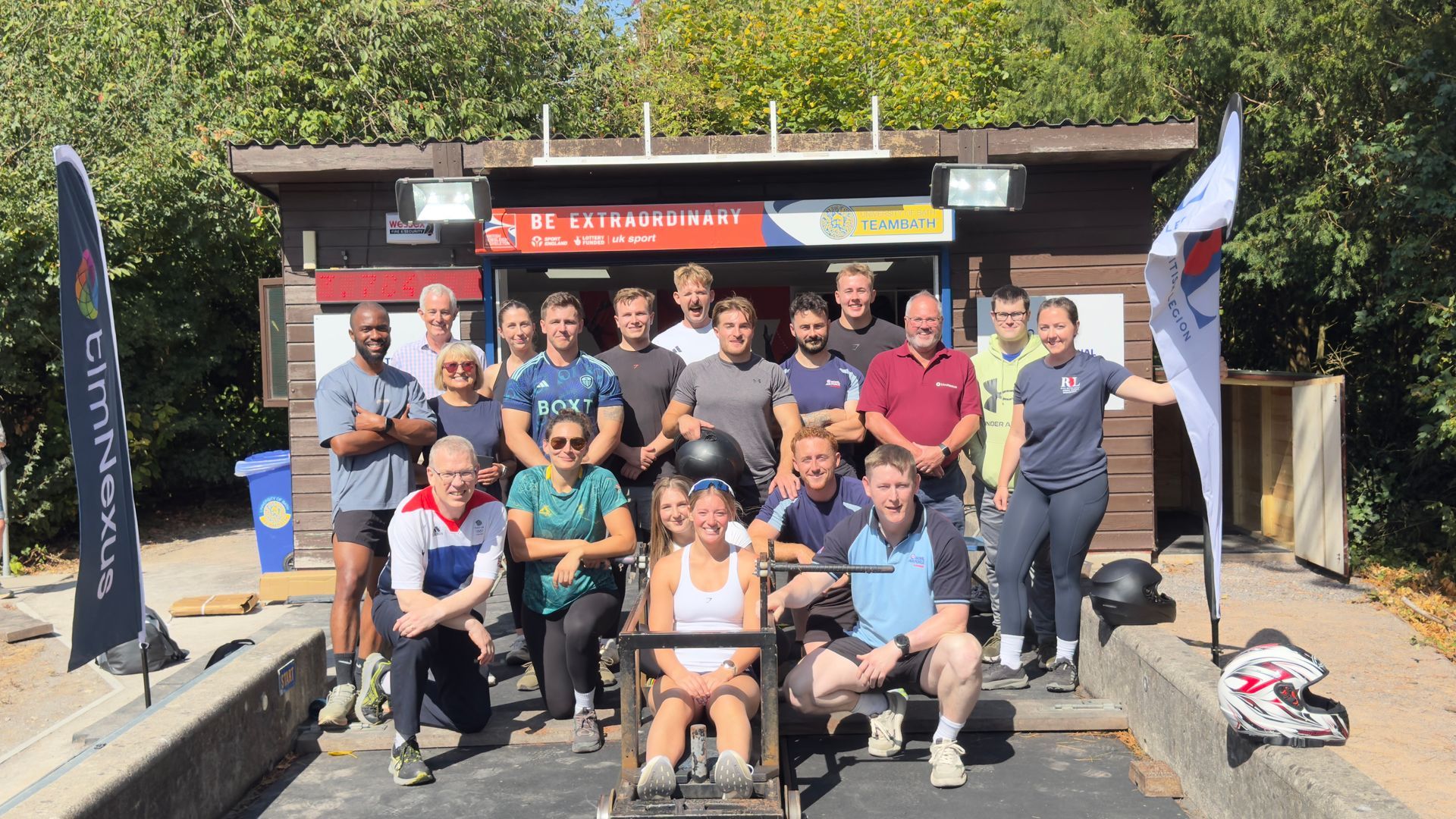
Our photograph shows members of the RAF BLSA after senior athlete testing at the University of Bath, with sponsors from tlmNexus and the Royal British Legion.